Dayton Regional S.T.E.M School
COLLEEN NICOLE FULTON
Portfolio
INTRO
11th Grade
Junior year has been an effective year preparing me for my future career in a variety of ways. From my knowledge of ergonomic factors relating to my work productivity, to the use of meeting notes and agendas for my professional communication. Even to getting to that point in my career with a solid foundation of basic math, understanding the how my government works and methods of understanding new and complicated school content. The following are projects in each of my classes that have contributed to this growth, the images to the left are the artifacts supporting those reflections.
INTRO TO ENGINEERING DESIGN
Northrop Grumman Project
Advanced Intro to Engineering Design (A-IED) is an elective I took this year that focused on both the engineering process as well as incorporating students into industrial knowledge. The most impactful project done in this class was working on the Northrop Grumman project. This endeavor was focused on creating an alternative building interior for Northrop Grumman with the Autodesk Architecture software. It has provided me the opportunity to grow in my knowledge of CAD software and develop effective workspaces.
This project was spanned across two terms of our school year and was organized by the end objectives. Our main goal was to produce an effective interior for Northrop Grumman’s building. This allowed us to basically scrap all walls and current furniture in the facility. We then collaborated with the organization to gather information on their employees such as the amount of workers they have, the percentage of what roles they fill under collaborative and independent work. We then took that knowledge and not only optimized the seating capacity of the existing space, but also used all ergonomic factors and specialized the areas based on either independent or collaborative work. Looking at furnisher from Hayworth, we picked out the pieces that complimented the kind of work we wanted to influence in the employees. For our programmers we built offices that really draws the workers attention to the project they are working on. While our engineers who need to collaborate, we are putting in more of an open workspaces, we are also providing series of breakout rooms. This can be demonstrated by the first artifact displayed at the left. Overall the building layout contributed to my growth by giving me a concept on how an environment can relate to a team’s productivity.
As we developed our layout, we also kept in mind LEED certifications (ecology-oriented building certification program run under USGBC) that we could incorporate into our building, this prompted us to use solar panels and solar tubes that collect natural energy. In addition the use of double doors to maximize the efficiency to keep a stable temperature in the large space. Throughout this entire process we were not only learning about effective workspaces, and LEED certifications, but we are using a completely new CAD software to build our ideas and revise them. 2016 Autodesk Architecture, was a new experience for all of us. Video tutorials were a helpful tool in this process to understanding the basics of floor layout and wall placement. Once we had the exterior and the original wall layout, we had no problem with taking the program a step further and building our own knowledge of how to render them and obtain a room view of our work. To the left is our final wireframe result of our building in the software label Artifact 2. This is the piece we used to present to a TECH Prep showcase my class attended. That was a viable experience that promoted us to wrap up into a final product and practice presenting, for later, we are going to be presenting our final class product to Northrop Grumman.
I plan to be using this information in the future to be able to put me and my work groups in an effective workspace that will promotes our most productive work. This project has highlighted to me that taking that extra step to consider the ergonomic factors can save more time and be just as effective.
TECHNICAL READING & WRITING
Grant Writing
This year I have taken a Technical Reading/Writing class, focusing on understanding and developing professional pieces of writing. In this unit we were introduced to the 2016 grant writing project addressing the driving question; how can we resolve education needs in our school? This question providing students an opportunity to develop a grant focusing on teachers needs in the school and conduct internal and external research to find a matching grants that will help our client teacher meet those needs. During this endeavor I have been provided an opportunity to collaborate with a teacher client and have obtain noticeable growth in my ability to communicate with my peers and professional staff. A skill that is used strongly for a student who is soon to be transitioning into an Engineering career where collaboration is a vital.
The first step in the learning process also contributed to the foundation of my growth. Each class was separated into groups that will create their own business identity. Then were required to learn a part of the ‘Grant Sections’ Article. Each section elaborates a critical piece of a Grant and demonstrates the best approach to take when developing it. These sections were made up of different chapters that we deviated out to our group members. We were required to learn new content and then prepared ourselves to teach that information to the rest of the class. My adopted chapter was focused on the problem statement of a grant. Based on my annotations of this chapters I was able to become a class expert and use the slide below as the key points to communicate to my class. What made this ‘Student Teacher’ sub-endeavor memorable was its ability to show me how much easier it is to learn content in regards of teaching it to my peers who were willing to learn.
After that experience I had a basic understanding on what makes up a grant and could transition into the bigger picture of what it takes to make an effective one. My group created a team identity and labeled ourselves, That One Company, and selected a client teacher who had a class need that we would build our grant off of achieving. Our client requested a document camera that she could use for her sixth grade English and world history classes. With that goal in mind, we expanded our knowledge in the different types of grants, donors, and grant-makers that could provide funds for those needs.
We were taught multiple methods to keep and sustain communication with our client teacher. This was done by a series of meetings. We learned that in the business world having a meeting takes a lot more than just stopping by when the time is convenient. I was lead in the client communications and I discovered that every meeting has to be planned a reasonable time ahead, that there is proper email adequate to follow to keep a professional persona, there are also Agendas that have to be developed. These Agendas were bulleted lists of the content we had to cover throughout the meeting. It had to have the correct layout of a title, date, location, a clear purpose and content displayed in an outlined format. Below if one of the agendas that we used to set up one of our meetings.
Overall this project has been quite impactful, I can see using the professional adult and peers communication skills in my future career. Not to mention how important it is to know the grant writing process based off of how incorporated grants are in fostering today’s society. I look forward to submitting my group’s works and awaiting the outcome of our work.
These new method of communicating a group’s work through my presentations to my Meeting requests and agendas, I can foresee being quite useful when I am working on my projects in the industry, or any engineering career. I not only look forward to exercising this knowledge to the business professionals in my career as becoming one.
ALGEBRA 2/TRIG
Chapter 2
In fifth period, Algebra 2/Trigonometry we went over Chapter 2: Properties of Functions. This would go over some of the familiar functions we reviewed in algebra and then introduce new terms. Over the time of this unit, I been able to grow in my ability recognize functions, determining their property, and defining them algebraically.
We started off by reviewing functions by graphical patterns. We reviewed Linear Functions, Quadratic Functions, Power functions, and Exponential Functions. Becoming familiar with the general equations and the Parent/transformed functions. Then we focused on looking at tables and being able to identify the functions from those numerical patterns. That’s where a new term of properties were introduced. Add – Add Pattern would represent a Linear Function, it obtains a constant slope, every time you add to x you also add a constant to the y value. An Add – Multiply pattern would represent an exponential function, meaning that when you add to the y, the x will be multiplied by the constant number. A multiply – multiply pattern would be for a Power Function. Meaning that you are doubling that value on the y and multiplying the value on the x. We took a while to review and practice the use of this content. One of my worksheets is listed, where we were using these properties to identify the type of functions and solve for the values. What I like about this artifact, was this is one of our first exercise sheets. Practicing the content we just learned. Overall this was a great review and allowed me to recognize these functions and identify the properties and equations that related to them.
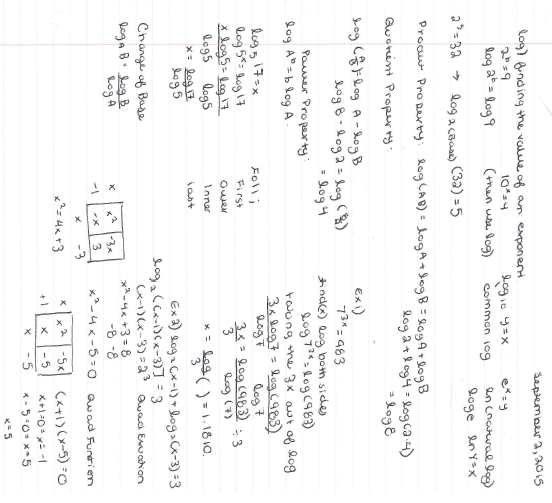
Then we were introduced to Logarithms. Which really confused me. However, I went through the content and reviewed the text book from at home. Which really allowed me to grasp the purpose and the laws of logarithms. Like how the difference of the format of exponential form vs logarithmic form. Or how a log plus a log = those values multiplied. Or how a log minus a log would equal those values divided. After becoming familiar with the basics, we moved into the Logarithmic Functions and processing how that relates to a Multiply – Add property in its data table. We then looked at the type of graph we get in a result of this process. So at this point, my knowledge on functions and properties were expanded with the introduction of the Logarithmic functions. The notes taken really helped me process, and get through my struggle of grasping the content.
I had a lot of trouble understanding this unit. But I was able to end with a good understanding of the content and how they related together. I was able to really quickly recognize different functions, defining them algebraically, and also determining the property. I am going to be using math a majority of my career as an engineer, this is a foundation of a whole new concept of math.
GOVERNMENT
The Matthew’s Bill (SB112)
One of the major endeavors promoted through our government class was a project called The Matthew’s Bill (SB112). By of participating in the SB112, I grew in my ability to understand how to campaign for a bill and the process of getting one passed.
Prior to starting this project, we researched and developed a basic understanding for what a bill is and then how it becomes a law. We were taught the process, starting with the introduction of the bill to either to the House or the Senate, where it is then discussed through a committee or subcommittee, revised and then voted on. The Committee reports are then created and marked on the calendar, for it is then reread, debated and revised with the addition of the amendments. After that, if it receives a full vote, then it is passed to the president who can either veto or pass the bill. If it is passed then it becomes a law. The image posted below is the votetocracy infographic that was provided to assist us in understanding this process. This was extremely helpful because I am a visual learner and being able to see the layout makes it easier to grow in my understanding how a bill gets passed into a law. It also came into mind whenever I found myself looking ahead and thinking whether or not a bill can pass this process and if that made them justified.
We then looked deeper into our content, discussing a new term of necessary and proper, which is a term that describes the certain powers that the US Congress have in the constitution. It gives them the ability to determine if a law is important enough to implement, and if it serves justice with its implementation. We were then given worksheets where we were provided case studies and we determined if they were necessary and proper. After reviewing the worksheets as a class the court’s ruling was revealed, allowing us to discuss the reasoning for the resulting outcome. It gives us a better understanding of what congress are looking for in a bill. Overall, to know the process and the minor details that contributes to the passing of a bill really allows you to analyze current bills and logically support the ones that are really have the potential to make it. It also lead us into our research assignment on SB112, also known as Matthews Bill.
The Matthews bill is a bill that was initiated in order to provide a changing table specialized for people suffering of disabilities who are above a weight and size limit for infant changing stations. What we had to do was determine if we felt that the bill was necessary and proper and then to support our position we created an argumentative essay that obtain references from legislative documents like the Bill of Rights, Ohio Constitution and the Americans with Disabilities Act.
In addition to our personal essays we worked together to further push forward the Matthew’s Bill. This included updating all campaigning materials and getting more organization and institutions to openly support the SB112. It was amazing to see how much work and growth is required to highlight a bill to your community through campaigning. Which I have learned to be a major part of giving the bill an opportunity to be passed. When we were introduced to campaigning we looked into how people in election for presidency appealed to the public during different periods of time. We looked into the buttons, posters, and speeches of the early age to the modern commercials, merchandise, and media bursts. The United States being a nation built off of the public, anything that could achieve the people’s approval is necessary. We used this knowledge to our advantage, splitting up into groups to that ranged from updating media, developing buttons, and even planning for events for us to attend in representation of SB112. My groups was in charge of contacting organizations and companies in our community to build partnerships, spread awareness, and potentially obtain sponsors. Posted below is a snip of the data we collected through Google docs. This was important because it was a virtual source that is accessible not only our group in the 3rd period group, but also the 6th period group who we were collaborating with to achieve the same objective. This was an entertaining process, trying to build relationships through emails and phone calls. Truthfully, I struggled with my lack of experience to professionally communicate over phone rather than in person. I believe it could of potentially lost us a few organizations that would have been willing if I approached them right. However, with the pressure to uphold my commitment of getting the support from the local community, I made it happen. I made the phone calls and learned how to present myself, through my tone and choice of words. Which was a success within itself.
In conclusion, I have been exposed to the understanding of the process a bill must take in order to become a law, and the qualifications that congress sets during that process. I have also been introduced to the world of campaigning, to knowing what it takes in terms of materials and outreach and also being able to now understand the impact it can have on a bill’s success. This is very important knowledge for me to obtain because I plan to be an active member in society and now I know how to promote change in my community though a bill.
CHEMISTRY
The Mole Unit
This quarter we looked into dimensional analysis and its relations to the molecular factor units. It required us to really learn the new terminology and practice the step by step process in order to complete the method. In this unit I have been able to grow in my ability to understand a process and implement it step by step in my work.
We first were introduced to dimensional analysis, through a series of simple examples and practice questions. After getting that basic idea of having a starting point and distributing it out to related variables we were then confronted by more complicated problems that took more variables to solve. One sheet in my chemistry notebook is attached to the left as first artifact, and it was just to demonstrate the repeated methods that allowed us to grasp the content. Once we became familiar with the main process allowed us to started looking into sigfigs. Or the amount of significant figures in a number, we went over how the amount of sigfigs at the start of dimensional analysis has to equal the amount of sigfigs at the end. This got us to the point where our process of dimensional analysis was easily read through step by step and ended in a defined amount in relation to sigfigs. Then we were introduced to molecular mass of an element. We learned how these were called moles and how this mass was represented in the chart of elements. We then started using them in our Dimensional Analysis and with lots of practice, this also became something that the step process is memorized and commonly exercised in our classwork. Becoming familiar with the relation of an elements grams to ever mole allowed us to expand to how the moles relate to molecules. The translation from grams to moles, and then from moles to mlc (molecules) we have learned to always be expressed through 6.02E23. Then that would further relate to how 1 mlc is further divided by the amount of atoms in a mlc in order to transfer from a starting amount in grams and to end in atoms.
So the content of dimensional analysis has been covered and greatly practiced through numerous labs and worksheets. The next step is taking our basic knowledge we received from the start of the unit and implementing them to come up with other results. For example, we learned about demonstrating percent composition. Which was simply just taking the molar mass and adding them up and dividing the initial amount of each element by the end result, multiplying it by one hundred, and then getting a percentage in result. Empirical Formulas was the next step, and it means to simplify the whole number ratio of atoms in a compound. We were giving percent compositions and were then able to convert that into the number of each element. Then we went into Molecular formulas, which is pretty much extending the process of the empirical and taking that formula adding up to see if the mole mass of the entire compound is the same as the provided molar mass. If not, then we would take the product and then find the closest whole numbers in order for it to exactly match. All of this was learned and then practiced, reviewed and tested. One of the labs we did to practice the knowledge was ‘Solving the crash (and crime) with chemistry’. The cover of this little project is attached below, but this was great for us to really test our skills and made it a lot of fun going through that process. For me, it helped me further improve my step by step understanding of the content we were learning.
I didn’t really have any major struggles, the steps made sense, however, I did have a little bit of an initial issue in the process of tearing apart some basic formulas, just because it was a lot of content to take in. I know the process it took to complete them, it was just identifying which was necessary. But with the continuous practice and the use of the different situations that I think that I have been able to grow in my ability to apply the step by step processes in scenarios at which they are needed in order to solve the questions. Now I am fully capable of seeing a question, being able to relate it to a certain method and then solve it with the step by step process I have grown to memorize.
I really did enjoy this quarter, all the content was easily related to one another, the process it was taught really gave us a foundation to become as comfortable as possible with the terminology. I am really looking forward to see how this knowledge is going to be applied in further units. I still have a lot more to learn before I am an engineer and this being an effective method I plan to build my education to its fullest understanding, using this as my example.
CLOSING
Thank you for Reading
This year has built a foundation for me to become an Engineer. Providing me skills and experiences I need to be effective in my career. I look forward to using these skills in the future ranging from group work, solving math problems, understanding new conent, using my professional communication skills, I have The Dayton Regional STEM School to thank for it.
Title
Title

Title
Title

Presentation at Tech Prep Fair
Presentation at Tech Prep Fair
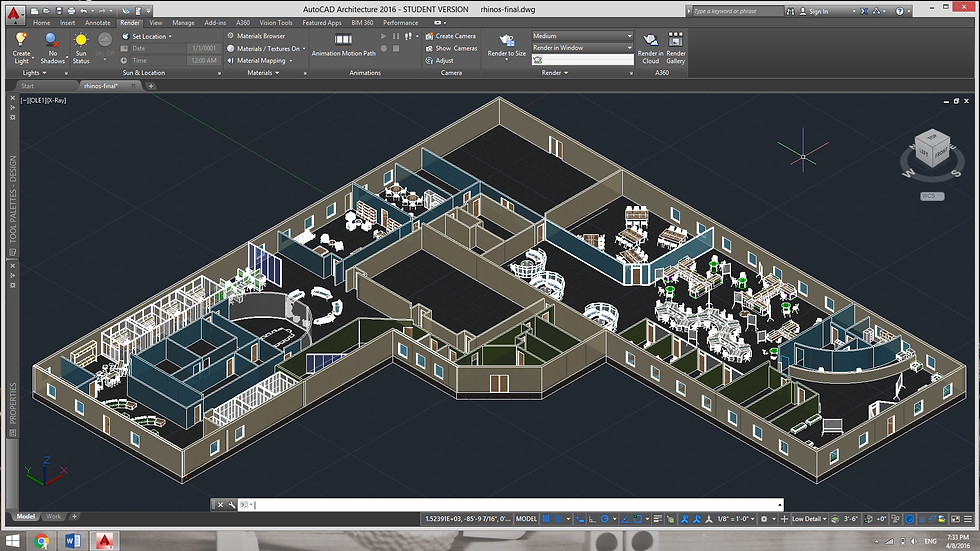
Final Northrup Grumman Layout
Final Northrup Grumman Layout

Collaborative Workspace
Collaborative Workspace


title
title

Title
Title

How a Bill Becomes a Law
How a Bill Becomes a Law

Collaboration Page for The Matthew's Bill
Collaboration Page for The Matthew's Bill

Name
Name

Name
Name